
Share your experience with the founderhere!

Nishil Patel
May 15, 2024
6 min read
Last Updated May 15, 2024

White box testing evaluates the correctness of your software's source code based on internal software design, code pathways, control flows, and logic. This article will guide you on concepts around white box testing, its benefits, what to cover in white box tests, and techniques you can employ to perform white box testing for your software.
1.
Introduction
2.
What is White Box Testing?
3.
What Are the Benefits of White Box Testing?
4.
What to Test in White Box Testing?
5.
White Box Testing Techniques
6.
White Box Testing vs. Black Box Testing: Quick Overview
7.
FAQs
White box testing evaluates a system's code logic, internal design and structure, and control flows. Based on the code-level exploration, you design test cases, write test scripts, and execute them to see whether or not the system works as expected.
Unlike black box testing, where you are concerned with the correctness of the system’s functions without knowing how it works internally, white box testing focuses on the correctness of a system's source code and internal workings. Let’s learn more.
White box testing is a software testing methodology to test and validate software source code and internal code workings to ensure they are error-free and function exactly as per the original system specs or requirements.
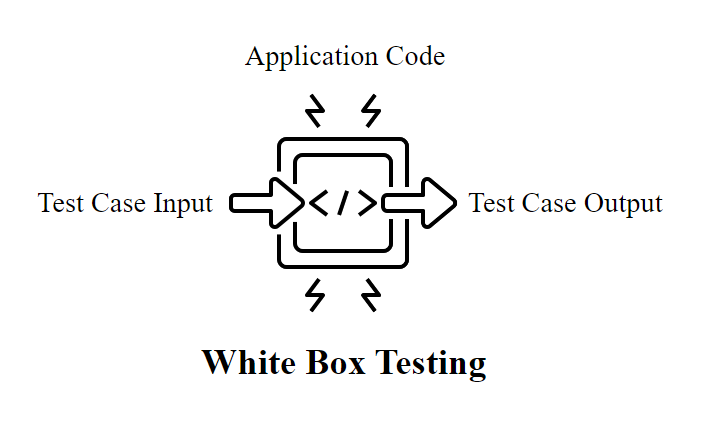
White box testing is also referred to by other names such as:
Some prominent open-source white box testing includes:
Here’s how white box testing benefits your software:
White box testing ensures error-free and quality-assured software code by evaluating the source code logic to identify and address underlying issues. It helps dig deep into the entire system from structural, logical, and design perspectives to identify critical errors that may have been overlooked or unapparent during black box testing processes.
Also Read: What is Quality Assurance? Definition, Methods, Benefits, & Roles
Unit testing in white box testing validates individual system components, functions, and modules. This helps maintain the source code integrity and proper functioning of these individual building blocks, ultimately leading to a polished end product.
Also Read: Unit Testing vs. Integration Testing
White box testing facilitates in-depth code coverage for testing. White box testing techniques such as — statement coverage, branch coverage, etc. — help measure how effectively your existing code runs and what areas in your system need attention.
White box testing is typically conducted since the early STLC phases. This facilitates early detection of software issues and helps ensure superior code quality throughout the development and testing lifecycle.
Also Read: Bug Life Cycle: Overview, Bug vs. Defect, reducing TAT for Bug Resolution
White box testing helps ensure the alignment, correctness, and validity of the source code as per the original project specs and system design. This helps meet intended business goals.
Black box testing doesn’t necessitate the understanding of programming language or internal code working while conducting tests. However, an understanding of how the code works — a requirement for conducting white box tests — can greatly strengthen the black box testing processes. This deeper insight into the source code’s mechanics allows for more comprehensive and effective testing. Simply put, the methodologies of white box testing can greatly complement and enhance the effectiveness of black box testing strategies.
Also Read: What is Black Box Testing?
White box testing especially benefits large-scale applications. It’s geared towards identifying and getting rid of unnecessary code, dead code, and spaghetti code. This not only helps keep software source code clean and optimized but also enhances system performance and maintainability in the long run. By eliminating redundant logic and unnecessary code, white box testing makes the code easier to understand and modify in the future, reducing maintenance costs.
Popular white box testing methods such as penetration testing and SQL injection vulnerability testing are absolutely crucial for all software to detect and identify any security issues. This helps fix any security loopholes to mitigate potential risks and threats in the system.
White box testing can be infused with the CI/CD pipelines since it requires working with the system source code. This helps white box testing align seamlessly with modern software development practices like the agile methodology at any or all stages of development and can be used with CI/CD pipelines and tools.
Also Read: Agile Testing: Best Practices
White box test cases once created can be later converted to automated tests whenever required. This significantly helps save time while using them as inputs for automation testing tools to conduct end-to-end testing and user acceptance testing methods.
Also Read: Top Automation Testing Tools in 2024
Here’s what to test while conducting white box testing for your software:
Code logic — verify the logical paths within the code for their correctness and efficiency. This involves checking conditional statements, loops, and decision-making steps to ensure they function as intended and handle all possible conditions.
Code coverage — ensure that all possible paths of execution in the code are tested. This includes testing every branch, loop, and condition to confirm that no part of the code is untested, which helps identify any hidden bugs.
Input/Output testing — test the application’s handling of I/O operations. This includes validating input data processing to ensure the output generated is accurate and consistent with the expected results.
Error and exception handling — assess the system’s ability to handle errors gracefully and let users know what exactly happened and what to do next. This involves intentionally triggering error conditions to verify that appropriate error messages are displayed and that the system does not crash or behave unpredictably.
Here are the top white box testing techniques:
Unit testing is a functional testing method that involves testing individual components or functions in a system to ensure that each works well individually. For instance, in an e-commerce application, if you have a function that validates credit card information, a unit test would confirm that the function returns true for a valid card number and false for an invalid one. Some prominent unit testing tools include JUnit(Java), PHPUnit(PHP), and pytest(Python).
Static testing refers to testing the source code without executing it to identify potential bugs, whereas dynamic analysis facilitates issue identification at runtime — when the code is being executed. For instance, static analysis might catch a syntax error in a loop, whereas dynamic analysis could catch a runtime error that occurs when the loop is executed. SonarQube, ESLint (JavaScript), and Pylint (Python) are some popular static code analysis tools. Popular dynamic analysis tools include Valgrind (Linux) and IBM Purify.
Path testing in white box testing validates the control flows in code. This method ensures that every possible route or path through a given part of the code or program is tested. For example, if your code has a conditional statement that can go two ways, path testing would involve creating tests that cover both branches of the condition to ensure all paths are tested.
This aims to execute every line of code at least once during testing. For instance, if you have a simple function with an if-else statement, statement coverage would require tests that result in both the if and the else blocks being executed.
Branch coverage tests each possible branch of a decision point in the code. For example, if you have nested if statements in your code, branch testing would test all possible outcomes of these conditions for validation.
Loop testing validates the correctness of all the conditional loops present in your code. For instance, testing a “for loop” that iterates over an array to ensure it processes and outputs each element correctly and then terminates as expected.
Let’s quickly compare white box with black box testing:
| Aspect | White Box Testing | Black Box Testing |
| Focus | Internal code structure | External functionality |
| Knowledge Required | Programming language, code structure | Software requirements, specifications |
| Test Design | Based on code logic, control flow | Based on user stories, functionalities |
| Objective | Ensure code correctness, identify logical errors | Ensure software meets requirements, user-friendliness |
| Notable Benefits | - Early error detection - Improved code coverage - Optimized code - Enhanced security | - User-centric testing - Lower false positives - Broader test coverage - Protects proprietary code |
| Techniques | - Unit testing - Static & dynamic analysis - Path testing - Statement coverage - Branch/Loop coverage testing | - Equivalence class testing - Boundary value testing - Decision table testing - State transition testing |
| Example | Testing individual functions/code logic in e-commerce shopping cart | Testing successful submission of a message form without understanding internal code workings |
Nishil is a successful serial entrepreneur. He has more than a decade of experience in the software industry. He advocates for a culture of excellence in every software product.
Meet the Author: Nishil Patel, CEO, and Co-founder of BetterBugs. With a passion for innovation and a mission to improve software quality.
We never spam.